Hardwood Lumber Company Floating Stair Treads are available in Maple, Walnut, White Oak, Hickory, and many other premium hardwood species. Combining modern manufacturing with traditional craftsmanship, our Amish woodworkers proudly handcraft each stair tread to your exact specifications at our facility in Warren, Ohio, providing nationwide shipping. Trusted for over 50 years, our team delivers custom floating stair treads that are not only beautiful but built to last.
Floating Stair Treads For Any Style
Floating stair treads by Hardwood Lumber Company are available in over 40 domestic and exotic hardwood species. We offer 8 custom finish options (including unfinished) and 3 construction styles: edge grain, flat sawn (wide plank), and face glued laminations. We’ll explain these construction styles in further detail below.
Not sure what wood species is right for your project?
Popular Floating Stair Tread Wood Species:
Each wood species is unique in its appearance and characteristics like hardness, durability, and grain pattern. Learn more about the best wood options for stair treads to make the right choice for your staircase.
Floating Stair Tread Finish Options
Finish options for your stair treads include unfinished and the following premium coatings:
- Tread Coat: A clear, low-VOC prefinished option that protects your treads while showcasing the natural wood grain. It offers a durable and easy-to-maintain satin finish.
- Tread Coat With Stain: This option combines the protection of our Tread Coat with a rich stain color, allowing you to customize the look of your stairs while maintaining their durability.
- Acrylic Polyurethane: A classic choice for a durable and long-lasting finish. This clear topcoat provides a protective layer that resists scratches and wear, available in a variety of sheens.
- Acrylic Polyurethane With Stain: Enhance the beauty of your chosen wood species with a stain, topped with a protective layer of acrylic polyurethane for maximum durability and a customized look.
- Rubio Monocoat: This hardwax oil finish provides deep penetration and a natural look with exceptional durability. It's a single-coat application that is easy to maintain and environmentally friendly.
- Primed & Painted: For a truly custom look, choose our primed and painted finish. Your treads arrive ready to install with a smooth, painted surface in the color of your choice. Please contact our team for an updated list of our available paint options.
- Primed White: This option provides a clean, classic white base that's ready for you to paint your desired color. It offers a smooth and consistent finish for easy painting.
While we can paint any wood type you choose, we highly recommend the following species for painted treads:
- Poplar: It has a fine, even grain, which creates a smooth surface for paint. It’s also relatively inexpensive, making it a budget-friendly option.
- Maple: Maple has a very tight grain, which also provides a smooth surface for paint. It’s harder than Poplar, so it offers greater durability, but at a higher cost.
- Pine: While softer and more prone to dents, pine is a cost-effective option for painted treads.
Note: We also recommend face grain construction for painted treads. You can learn more about construction styles below.
Floating Tread Construction Options
We offer three distinct construction styles for our floating stair treads to meet your architectural needs:
- Face Grain (Wide Plank)
- Face grain treads showcase the broad surface of the wood, revealing natural grain patterns. This orientation creates a rustic aesthetic but is less stable and more prone to warping and cracking than edge grain.
- Face Glued
- Face glued treads are constructed by laminating layers of solid face grain boards together to provide a thicker and stronger step than face grain alone. Since most hardwood lumber is only available up to 1-3/4" thick, face glued allows for a thicker stair but with the same wide plank (face grain) look.
- Edge Grain
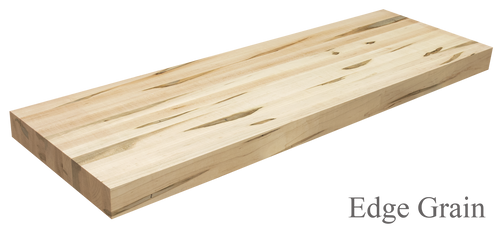
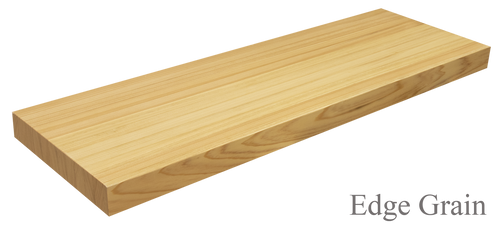
- Edge grain treads display the narrow edges of wood planks, creating a tight, uniform grain pattern lengthwise. This construction method offers superior stability, minimizing warping and movement, which makes it ideal for floating stairs. Compared to face grain, edge grain provides a more consistent, durable surface and less dramatic grain variation.
Floating Stair Treads FAQs
What are floating stair treads?
Floating stair treads are steps that appear to float in mid-air, mounted without visible support structures like risers or stringers.
What is the standard size of a stair tread?
Building codes typically require a minimum tread depth of 10 inches. However, the ideal tread depth for comfortable and safe use is around 11 inches.
How thick should floating stair treads be?
Typical thickness ranges from 2 to 4 inches. At minimum, hardwood treads should be 1 ¼” thick. We offer custom treads from 1 ¼” to 4 ½” in thickness.
Are floating stair treads safe?
Yes, when properly designed and installed, floating stairs are structurally sound and safe. They must adhere to local building codes and regulations. Properly engineered floating treads can safely support heavy loads, meeting or exceeding standard weight capacities required by code.
How do you attach floating stair treads to the wall?
Floating stair treads are attached using hidden brackets, pins, or anchors secured to wall framing or reinforced structural elements.
Can floating stairs be installed against any type of wall?
No, floating stair treads require strong, structurally reinforced walls or additional support elements. They typically cannot be installed solely into drywall or plaster.
Can floating stair treads be retrofitted into an existing home?
Yes, floating stair treads can be retrofitted, but structural reinforcement of walls or adjacent support structures will usually be necessary.
How do I clean and maintain floating stair treads?
Regularly dust or vacuum, then wipe with a damp cloth. Avoid harsh chemicals; use cleaners specifically suitable for your custom wood finish and tread material.